DAISYWORLD CAL 26:
EMILY BATES, "paulownia trees produce seeds"
JULY 23-28, Greater Heat
Emily Bates follows the drifting paths of seeds, memory, and migration through a summer of Code Reds.
Commissioned and published by @daisyworldcal:
A microseasonal artist calendar.
One year, 72 microseasons, 72 artists.
Available on Substack.
I’ve taken refuge in the canal waters.
The first Code Red warning for a heatwave in the Netherlands.
The water brown and warm yet refreshing with a slight surface breeze.
I’m loosely attached to my orange visibility float that I normally keep for colder swims, in quieter times.
Now kids jump in from the bridge, screeching.
Others play on inflatable forms: crocodiles, doughnuts and ‘tompouce’, a Dutch pastry.
I drift gently using the air filled form as a pillow, imagining myself as a sea bean.
My thoughts are of seas and waves elsewhere.
Places I long to return to, still for now out of reach.
The canal navigates my local neighbourhood, the park and green spaces which guided me through the Covid era and beyond, inviting blossoms and blooms into my work.
Later making inks and pigments from berries, petals and barks.
I began collecting stories and seeds along the way as the seasons morphed.
Sea beans, exotic seeds, travel from distant shores by sea currents.
But seeds also migrate in animal droppings, in the winds, and wings of birds, not only by human intervention, ignorance or greed.
Intentional or otherwise, the spread of specimens and trees is far reaching geographically, and in ecological impacts.
I have tended to ignore the branches of the foxglove tree with its purple flowers.
Perhaps this entwines with my discomfort for rhododendrons and toxicity (a chapter I will save for another occasion).
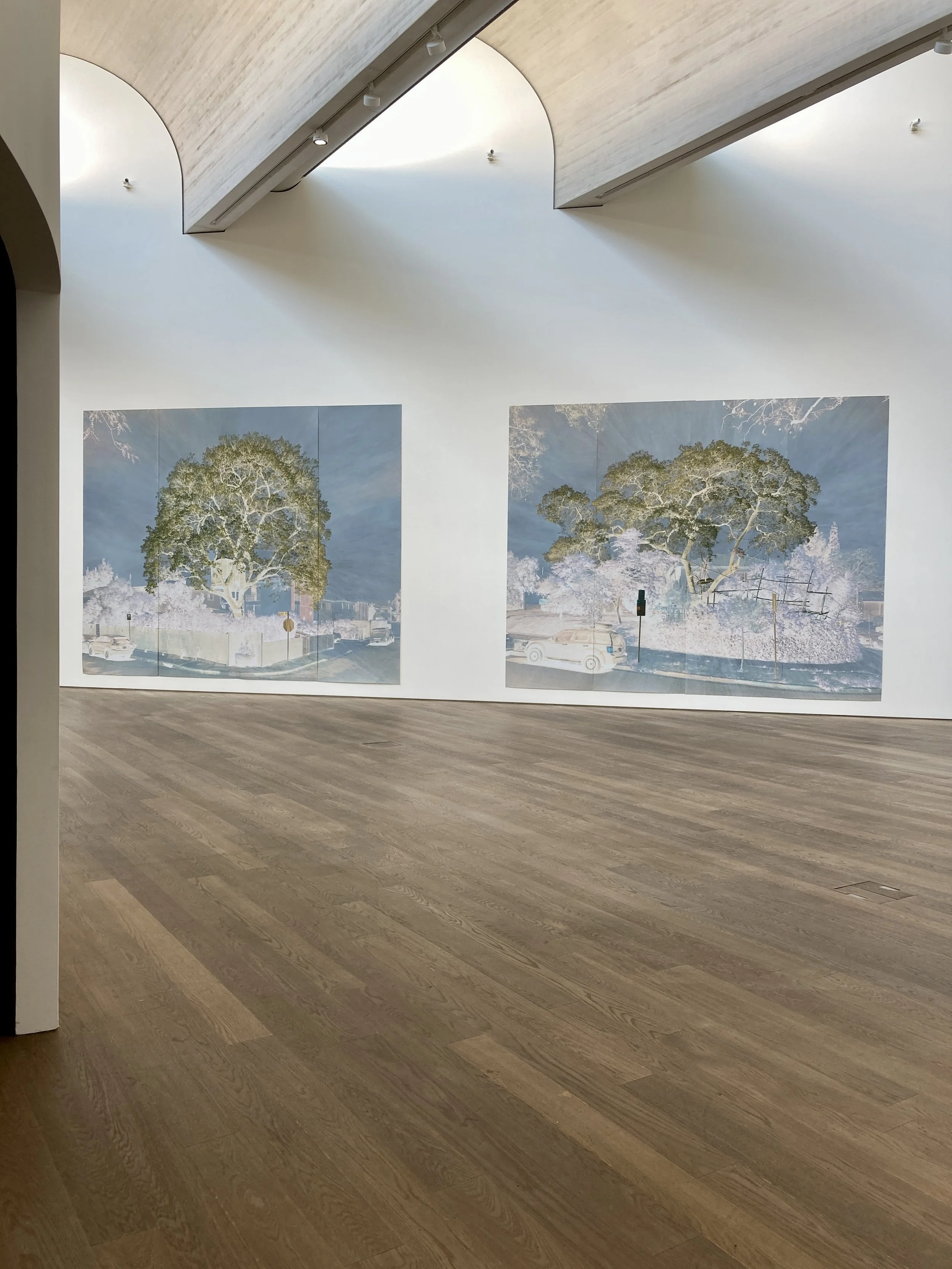
Though I am now reminded of Tacita Dean’s majestic series, Purgatory, made for The Dante Project, 2020-21. Her analog photographs of the Jacaranda tree’s purple flower, exposed in negative, creating a surreal distortion of ‘between’ worlds.
Shown later in MUDAM museum in Luxembourg, I was fortuned to experience them in their full scale accompanied by the ballet’s score emanating from her video work of the project, (and with my work The sky is glowing with the setting sun, simultaneously on display in another gallery of the museum).
The foxglove tree, the princess tree, or empress tree, is also known as the Paulownia tree, or kiri in Japan. Brought from Japan to the Netherlands by naturalist Philip Franz von Siebold in 1823, it was presented in tribute to the reigning Dutch Queen, Anna Pavlovna, daughter of the Russian Tsar.
Considered a sacred tree and bearer of good fortune, particularly when a girl is born, the flower is also used as the emblem of the Japanese government.
I’m still a buzz with this multi layered migration story, and the ability for my canal swim to wash me upon the Japanese shores once more, just as I thought it was out of reach. The project once more postponed.
I’m searching for the tree. I know I saw it not far away. And yet without the purple flowers to guide me, I feel lost.
It’s a summer of Code Reds.
The opera of the sky commenced dramatically, replacing the planned Opera in the Park as part of the Holland Festival.
One hundred and eighty thousand lightning strikes stretching across the city in one night!
Cycling hurriedly through the city, completely drenched, the sky darker and more explosive with each turn of the wheel, Hiroshi Sugimoto’s Lightning Fields resurface in my memory.
The next morning, I feel emotionally drained, apocalyptic, yet there is a cleansing and freshness to the day.
A questioning: Was it just a dream?
I cycle through the park some days later.
Branches fallen, scattered.
And then, a pile of the empress’s limbs reveals themselves.
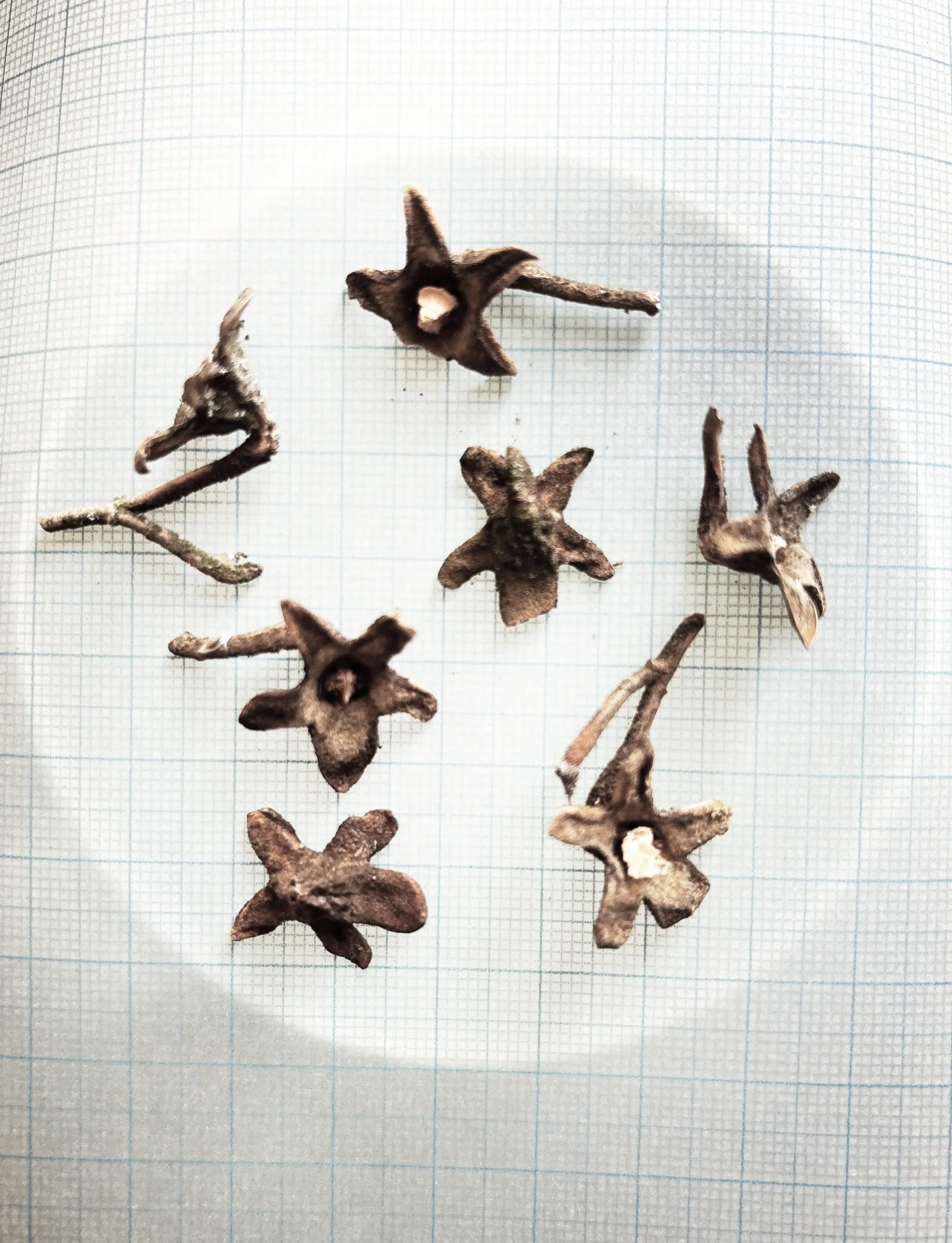
The flowers long gone, replaced now by brown seed husks, chandelier like, along the broken stems.
I gather them up, filling my bike bags, as the tiny light seeds sprinkle and fall from the crisp pods most already opened like hungry birds’ beaks.
The closed pods rattle gently.
The seed husks were once used as packaging for fragile porcelain treasures, shipped from Asia, long before the invention of plastic bubble wrap and polystyrene.
The husk’s structure simultaneously strong and pressure absorbing until it is required to collapse, seems ideal for the purpose.
Attached to the branch stem with a five pointed star, the pods interior is perfectly divided into four chambers.
Our four seasons. They too collapse and distort, and multiply.
The 72 micro-seasons honoured here, offering us the opportunity to both slow and stretch time as we pause to give attention, take a moment, notice a happening.
To celebrate.
Back in the water.
This time was another time, another heatwave.
A natural body of water upon a former field, reserved for birds and wildlife.
I slip in, the water shallow and warm. Enveloped in the summer evening darkness, I quietly look up, and float in a galaxy of stars.
I am not the only traveller here.